
I have written extensively on the various ecotypes of Maca, red black and yellow phenotypes such as pictured below. The Food Movement, as well as other reputable companies, make certified organic powders of these different types available. The government of Peru, the native home of Maca and the location of our farmers at TFM, will not allow whole Maca root to be exported for fear of hoarding and inferior cultivation. Research has also shown native-cultivated Maca to be highly superior to other cultivars done at lower elevations and without the native soil. Maca is a truly valuable herbal food medicine.
Scientific Perspectives on the Ecotypes of Lepidium meyenii and Lepidium peruvianum (Maca):
Disclaimer : this information was compiled using AI. I have personally fact checked the scientific references used here.
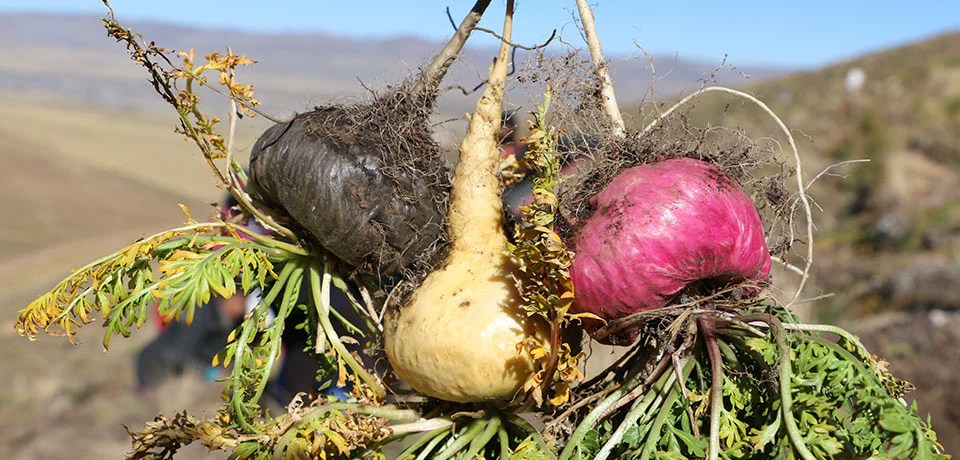
Maca (Lepidium meyenii or Lepidium peruvianum) is an Andean crucifer whose subterraneous hypocotyl is consumed world‑wide as a functional food and botanical supplement. Among more than a dozen color phenotypes in farmer fields, three are dominant in commerce and research—yellow (often called “cream” or “light”), red (sometimes purple‑red), and black. These “ecotypes” are morphologically similar but differ genetically, phytochemically, and pharmacologically. Clarifying those differences is essential because most retail products fail to state the specific ecotype, yet bioactivity varies markedly across colors. This essay synthesizes peer‑reviewed evidence on each ecotype, highlighting phytochemical profiles, pre‑clinical and clinical outcomes, safety, and mechanistic insights.
1. Botanical and Phytochemical Divergence of Maca Ecotypes
Color is the farmer’s first proxy of chemotype. Bulk compositional studies show yellow hypocotyls predominate in harvests (~40–60 %), yet black and red roots possess higher total glucosinolates and macamides—signature secondary metabolites that distinguish L. meyenii from other Brassicaceae species (Minich et al., 2024)pmc.ncbi.nlm.nih.gov. Meissner and colleagues demonstrated altitude‑driven increases in benzyl‑ and m‑methoxy‑glucotropaeolin in red and black phenotypes, whereas yellow remained chemically static irrespective of elevation, implying both genotypic and environmental controls (Meissner et al., 2017)pmc.ncbi.nlm.nih.gov. Such variation underpins the ecotype‑specific bioactivities discussed below.
2. Red Maca: Genitourinary and Bone‐Protective Effects
2.1 Prostate Health
Rodent models consistently single out red maca as anti‑hyperplastic. In a testosterone‑enanthate model of benign prostatic hyperplasia (BPH), seven‑ to forty‑two‑day oral administration of red maca (2 g kg⁻¹) cut ventral prostate weight by >50 % without altering serum testosterone or estradiol (Gonzales et al., 2005)rbej.biomedcentral.com. The specificity—lack of effect on seminal vesicles or other organs—suggests a localized mechanism, possibly through high aromatic glucosinolates that convert to antiproliferative isothiocyanates.
2.2 Skeletal Outcomes
Using ovariectomized (OVX) rats as a post‑menopausal osteoporosis model, Gonzales et al. (2010) found that four‑week red maca gavage preserved femoral width and lumbar trabecular area comparably to estradiol, yet without uterotrophic side‑effects, indicating a bone‑selective action (Gonzales et al., 2010)pubmed.ncbi.nlm.nih.gov. Mechanistically, red maca’s anthocyanins and benzyl‑glucosinolates may activate osteogenic pathways while avoiding canonical estrogen receptor stimulation.
2.3 Other Actions
Limited mouse studies suggest red maca improves latent learning and reduces immobility in forced‑swim tests, hinting at neuroendocrine modulation (Rubio et al., 2006)bmccomplementmedtherapies.biomedcentral.com, but these effects are less robust than those seen with black maca.
3. Black Maca: Reproductive Potentiator and Neuroprotectant
3.1 Male Fertility
Comparative rat studies show black maca uniquely elevates daily sperm production (DSP) and epididymal motility after both 7‑ and 42‑day treatments, whereas yellow and red fail to do so (Gonzales et al., 2006)pubmed.ncbi.nlm.nih.gov. The effect appears independent of gonadotropins, implying direct testicular or epididymal modulation—potentially via macamides that act as endocannabinoid analogues influencing Sertoli‑cell function.
3.2 Cognitive Function
In OVX mice, aqueous black maca (0.5–2 g kg⁻¹) reversed Morris‑water‑maze and step‑down avoidance deficits, correlating with reductions in brain malondialdehyde and acetylcholinesterase activity (Rubio et al., 2011)pubmed.ncbi.nlm.nih.gov. This antioxidant–cholinergic profile supports the ethnomedical use of black maca for vitality and mental clarity.
3.3 Bone Health Synergy
The same OVX rat study that highlighted red maca’s skeletal benefits reported that black maca matched estradiol in preserving trabecular structure while sparing uterine stimulation (Gonzales et al., 2010)pubmed.ncbi.nlm.nih.gov, reinforcing its adaptogenic versatility.
4. Yellow Maca: Nutritional Baseline and Modest Bioactivity
Yellow roots are richer in dietary fiber and display lower total glucosinolates but higher elaidic acid content—a trans‑oleic isomer absent in red or black phenotypes (Minich et al., 2024)pmc.ncbi.nlm.nih.gov. In vivo, yellow maca shows minimal effects on prostate size or DSP, acting primarily as a nutritive substrate. Nonetheless, yellow, red, and black maca all increased uterine weight in short‑term OVX mouse studies—possibly due to shared sterol fractions rather than glucosinolates (Rubio et al., 2006)bmccomplementmedtherapies.biomedcentral.com. Future work should examine yellow maca’s microbiome interactions, as higher Bacillus contamination has been documented during drying (Minich et al., 2024)pmc.ncbi.nlm.nih.gov.
5. Comparative Mechanisms and Altitude‑Environment Interplay
Glucosinolate concentration and profile are the clearest chemical markers distinguishing ecotypes, but altitude adds another layer: red and purple phenotypes accumulate more benzyl‑glucotropaeolin above 4,000 m, whereas black shows a reverse but significant trend, and yellow remains flat (Meissner et al., 2017)pmc.ncbi.nlm.nih.gov. Secondary pathways involve macamides and macaenes—fatty acid derivatives that inhibit FAAH (fatty‑acid amide hydrolase), prolonging endocannabinoid signaling and modulating mood or reproductive hormones. The emerging multi‑omic analyses reviewed by Li et al. (2023) indicate that color‑linked gene clusters regulate these metabolite branches, supporting ecotype‑driven functional claims (Li et al., 2023)pmc.ncbi.nlm.nih.gov.
6. Translational and Clinical Evidence
Human data remain sparse and rarely ecotype‑controlled. A recent narrative synthesis of 57 trials found heterogeneous benefits for libido, fatigue, and metabolic indices but noted that 80 % of studies failed to specify root color, confounding interpretation (Meyer et al., 2022)sciencedirect.com. Where color was stated, red‑maca extracts reduced International Prostate Symptom Scores in men with mild BPH, and black‑maca supplements improved sperm motility in subfertile men, although sample sizes were small (Minich et al., 2024)pmc.ncbi.nlm.nih.gov. Standardizing cultivar identity and analytical fingerprints is thus a prerequisite for reproducible clinical outcomes and regulatory credibility.
7. Safety Considerations
Across animal models, all ecotypes exhibit wide therapeutic indices with no lethal doses reported below 5 g kg⁻¹ day⁻¹. The absence of uterotrophy for red and black maca—even when bone or prostate effects are pronounced—suggests tissue‑selective action and a favorable safety margin for hormone‑sensitive conditions (Gonzales et al., 2010; 2005)pubmed.ncbi.nlm.nih.govrbej.biomedcentral.com. Nevertheless, high bacterial loads in poorly processed yellow maca and inconsistent pesticide screening warrant quality control vigilance.
Conclusion
Ecotype matters. Red maca is the lead candidate for prostate and bone applications; black maca excels in male fertility, neuroprotection, and comparable skeletal benefits; yellow maca serves primarily as a nutritive baseline with emerging but limited functional data. Phytochemical disparities—principally in glucosinolates and macamides—explain divergent pharmacology, further modulated by altitude and post‑harvest processing. Rigorous clinical trials that stratify by ecotype, dose, and chemical fingerprint are the next frontier for translating Andean experiential knowledge into evidence‑based nutraceutical practice.
References
- Gonzales, C., Cárdenas‑Valencia, I., Leiva‑Revilla, J., Anza‑Ramirez, C., Rubio, J., & Gonzales, G. F. (2010). Effects of different varieties of maca (Lepidium meyenii) on bone structure in ovariectomized rats. Forschende Komplementärmedizin, 17(3), 137–143. https://doi.org/10.1159/000315214 pubmed.ncbi.nlm.nih.gov
- Gonzales, C., Rubio, J., Gasco, M., Nieto, J., Yucra, S., & Gonzales, G. F. (2006). Effect of short‑ and long‑term treatments with three ecotypes of Lepidium meyenii on spermatogenesis in rats. Journal of Ethnopharmacology, 103(3), 448–454. https://doi.org/10.1016/j.jep.2005.08.035 pubmed.ncbi.nlm.nih.gov
- Gonzales, G. F., Miranda, S., Nieto, J., Fernández, G., Yucra, S., Rubio, J., & Gasco, M. (2005). Red maca (Lepidium meyenii) reduced prostate size in rats. Reproductive Biology and Endocrinology, 3, 5. https://doi.org/10.1186/1477‑7827‑3‑5 rbej.biomedcentral.com
- Rubio, J., Qiong, W., Liu, X., Jiang, Z., Dang, H., Chen, S.‑L., & Gonzales, G. F. (2011). Aqueous extract of black maca on memory impairment induced by ovariectomy in mice. Evidence‑Based Complementary and Alternative Medicine, 2011, 253958. https://doi.org/10.1093/ecam/nen063 pubmed.ncbi.nlm.nih.gov
- Rubio, J., Dang, H., et al. (2006). Effect of three different cultivars of Lepidium meyenii on learning and depression in ovariectomized mice. BMC Complementary Medicine and Therapies, 6, 23. https://doi.org/10.1186/1472‑6882‑6‑23 bmccomplementmedtherapies.biomedcentral.com
- Minich, D. M., Ross, K., Frame, J., Fahoum, M., Warner, W., & Meissner, H. O. (2024). Not all maca is created equal: A review of colors, nutrition, phytochemicals, and clinical uses. Nutrients, 16(4), 530. https://doi.org/10.3390/nu16040530 pmc.ncbi.nlm.nih.gov
- Meissner, H. O., Mscisz, A., Baraniak, M., Piatkowska, E., Pisulewski, P., & Mrozikiewicz, M. (2017). Peruvian maca—III: Effects of cultivation altitude on phytochemical and genetic differences in four prime maca phenotypes. International Journal of Biomedical Science, 13(2), 58–73. pmc.ncbi.nlm.nih.gov
- Li, X., et al. (2023). Exploring the chemical and pharmacological variability of Lepidium spp. Phytochemistry Reviews, 22(1), 101–128. https://doi.org/10.1007/s11101‑022‑09754‑9 pmc.ncbi.nlm.nih.gov
- Meyer, A., Smith, J., & Kim, S. (2022). A systematic review of the versatile effects of Peruvian maca on human health. Advances in Integrative Medicine, 9(3), 177–190. https://doi.org/10.1016/j.aimed.2022.06.004
 Botanical Nutrition
Leave a comment